
Canadian Malting Barley Situation
- Monday, March 17, 2003
This analysis featured in the March 17, 2003 issue of the HGCA's MI Prospect, Volume 5, Number 19
Following two drought reduced barley crops Canadian supplies of malt and malting barley have been very limited this year. While a full recovery in supplies is possible, some thing rather less is likely and its impact will in any event only be felt on world markets late in the year.
Key points
- Canada, a major source of malting barley,
- suffers two successive droughts
- Production could recover in 2003,
- but export supplies not until late in the year
In a normal year Canada exports about 1.3 million tonnes of malting barley, on a par with the two other major exporters the EU and Australia. Together the three typically account for about 90 percent of world trade in malting barley. Further Canada exports about 700,000 tonnes(barley equivalent) of barley malt, about 15 percent of the international market which is dominated by the EU.
Canada normally harvests about 13 million tonnes of barley for all uses. About 10 millions tonnes of this is typically fed. Barley is the most important feed grain in Canada and this is particularly so in the major barley production regions. In excess of 2 million tonnes is selected for malting with the balance being exported for feed purposes.
In 2001 Canadian barley production was reduced by drought to under 10.8 million tonnes, the lowest level in over ten years, but the malting barley supply was not too adversely effected as US maize, which was relatively inexpensive that year, was imported as a substitutes feed and carryover stocks were run down.
In 2002 Canadian barley production was reduced by drought to 7.3 million tonnes, the smallest crop in over thirty years, and the US maize option was expensive. Alberta feed barley prices, with which the malting sector had to compete, rose very immediately to Can$200, about £85, per tonne, and by mid September the Canadian Wheat Board was predicting pool returns, basis tide water positions, for 2-row malting barley of Can$230 per tonne which has subsequently been raised to Can$252, about £110, per tonne. Canadian exports of malt and malting barley this season are expected to be less than 900,000 tonnes, and less than half normal levels(Chart 1).
continueChart 1
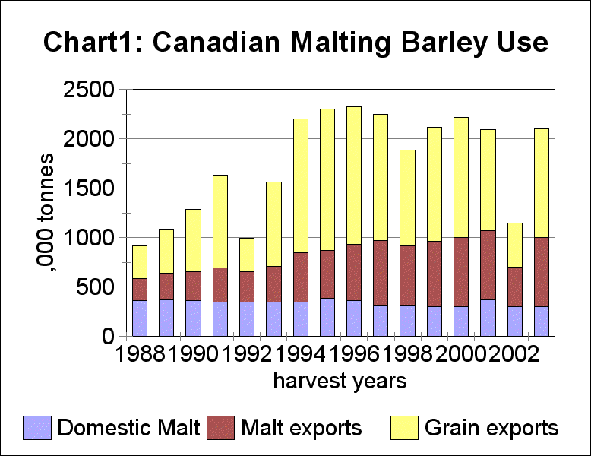 Source: Canadian Wheat Board
continued
Because of the flexibility of the Canadian malting barley production and marketing system, it is entirely possible for Canada to be back in international markets next year with typical supplies. Such an immediate and total recovery is, however, unlikely. The bulk, almost 80 percent in 2002, of the Canadian barley crop is seeded to malting varieties. But much of that quality potential is lost to the weather - too hot and dry during ripening or too wet at harvest.
It is further evident that the livestock industry will have some way to go to build strategic reserves and it will almost certainly be the feed barley market that will push malting barley prices. Hence, quantity will be quite as important as quality, as was the case this year.
It will require a typical crop of about 13 million tonnes to do this. This would require, either both adequate and as importantly well timed moisture during the growing season because of significant existing soil moisture deficits, or an unusually large acreage.
What can be said with some certainty is that because of the lateness of the Prairie harvest and the nature of the Canadian marketing system, the impact of any increase in Canadian malt and malting barley supplies will not be felt until the end of the calendar year.
David Walker
phone: 01603 705153
top of page